Craps

Random Dice toss

Spread the love


This is where we all started(and sometimes feel like we are going back to)

[/tables] [clear][/clear]


Replies:

Posted by: Guest on August 4, 2012, 11:08 pm

Posted by: Finisher on August 12, 2012, 12:04 am

It should read the perfect random toss for I for one have never throw this in a 36 roll .There is always a difference. It is strange that in the LONG run it comes out that way. All those point 7s make up for those 40-50- or ??? rolls that we may have. It would be great if we only KNOW.
Good Rolling. πŸ˜€

Posted by: Guest on August 15, 2012, 8:10 pm

Re: Random Dice toss

Postby Finisher Β» 11 Aug 2012 20:04
It should read the perfect random toss for I for one have never throw this in a 36 roll .There is always a difference. It is strange that in the LONG run it comes out that way. All those point 7s make up for those 40-50- or ??? rolls that we may have. It would be great if we only KNOW

One should not expect to toss a perfect Random Roll probability in one 36 roll toss.

Here is an answer given by another at http://wizardofodds.com/ask-the-wizard/craps/dice/

What is the expected number of rolls of two dice for every total from 2 to 12 to occur at least once?
β€” SixHorse

This question was asked at TwoPlusTwo.com, and was answered correctly by BruceZ . The following solution is the same method as that of BruceZ, who deserves proper credit. It is a difficult answer, so pay attention.

First, consider the expected number of rolls to obtain a total of two. The probability of a two is 1/36, so it would take 36 rolls on average to get the first 2.

Next, consider the expected number of rolls to get both a two and three. We already know it will take 36 rolls, on average, to get the two. If the three is obtained while waiting for the two, then no additional rolls will be needed for the 3. However, if not, the dice will have to be rolled more to get the three.

The probability of a three is 1/18, so it would take on average 18 additional rolls to get the three, if the two came first. Given that there is 1 way to roll the two, and 2 ways to roll the three, the chances of the two being rolled first are 1/(1+2) = 1/3.

So, there is a 1/3 chance we’ll need the extra 18 rolls to get the three. Thus, the expected number of rolls to get both a two and three are 36+(1/3)Γ—18 = 42.

Next, consider how many more rolls you will need for a four as well. By the time you roll the two and three, if you didn’t get a four yet, then you will have to roll the dice 12 more times, on average, to get one. This is because the probability of a four is 1/12.

What is the probability of getting the four before achieving the two and three? First, let’s review a common rule of probability for when A and B are not mutually exclusive:

pr(A or B) = pr(A) + pr(B) – pr(A and B)

You subtract pr(A and B) because that contingency is double counted in pr(A) + pr(B). So,

pr(4 before 2 or 3) = pr(4 before 2) + pr(4 before 3) – pr(4 before 2 and 3) = (3/4)+(3/5)-(3/6) = 0.85.

The probability of not getting the four along the way to the two and three is 1.0 – 0.85 = 0.15. So, there is a 15% chance of needing the extra 12 rolls. Thus, the expected number of rolls to get a two, three, and four is 42 + 0.15Γ—12 = 43.8.

Next, consider how many more rolls you will need for a five as well. By the time you roll the two to four, if you didn’t get a five yet, then you will have to roll the dice 7.2 more times, on average, to get one, because the probability of a five is 5/36 = 1/7.2.

What is the probability of getting the five before achieving the two, three, or four? The general rule is:

pr (A or B or C) = pr(A) + pr(B) + pr(C) – pr(A and B) – pr(A and C) – pr(B and C) + pr(A and B and C)

So, pr(5 before 2 or 3 or 4) = pr(5 before 2)+pr(5 before 3)+pr(5 before 4)-pr(5 before 2 and 3)-pr(5 before 2 and 4)-pr(5 before 3 and 4)+pr(5 before 2, 3, and 4) = (4/5)+(4/6)+(4/7)-(4/7)-(4/8)-(4/9)+(4/10) = 83/90. The probability of not getting the four along the way to the two to four is 1 – 83/90 = 7/90. So, there is a 7.78% chance of needing the extra 7.2 rolls. Thus, the expected number of rolls to get a two, three, four, and five is 43.8 + (7/90)Γ—7.2 = 44.816.

Continue with the same logic, for totals of six to twelve. The number of calculations required for finding the probability of getting the next number before it is needed as the last number roughly doubles each time. By the time you get to the twelve, you will have to do 1,023 calculations.

Here is the general rule for pr(A or B or C or … or Z)

pr(A or B or C or Z) =
pr(A) + pr(B) + … + pr(Z)
– pr (A and B) – pr(A and C) – … – pr(Y and Z) Subtract the probability of every combination of two events
+ pr (A and B and C) + pr(A and B and D) + … + pr(X and Y and Z) Add the probability of every combination of three events
– pr (A and B and C and D) – pr(A and B and C and E) – … – pr(W and X and Y and Z) Subtract the probability of every combination of four events

Then keep repeating, remembering to add probability for odd number events and to subtract probabilities for an even number of events. This obviously gets tedious for large numbers of possible events, practically necessitating a spreadsheet or computer program.

The following table shows the the expected number for each step along the way. For example, 36 to get a two, 42 to get a two and three. The lower right cell shows the expected number of rolls to get all 11 totals is 61.217385.

Posted by: Finisher on August 16, 2012, 5:18 am

Cll I read it ALL but did not get the answer . I just really want to know the probability of rolling the random roll of the dice the way you stated a random roll for 36 rolls look like. For it seems that it does not happen that often in a short roll.
So say you have 1000 sessions of 36 rolls will there be 1.2 or more that looks like your chart or none at all?
I look at it as it would only take making one extra number to mess up the chart be it a crap number or box number or an extra 7.
Your charts are GREAT . I would love to see one of your practice rolls in chart form just to get a better idea what a non-perfect roll looks like.
I am not a math guy so this is past me but thought that it would be interesting to see some ideas .
A different way of looking at it is I cant even throw the dice in the random way that is in your chart. Go fig.
Keep up the great charts and Good Rolling. πŸ˜€ πŸ˜€

Posted by: Guest on August 16, 2012, 2:34 pm

Finisher asked,
So say you have 1000 sessions of 36 rolls will there be 1.2 or more that looks like your chart or none at all?
I look at it as it would only take making one extra number to mess up the chart be it a crap number or box number or an extra 7.

I believe I understand your consternation. It is difficult to equate the math of Craps with the reality that one sees every day at the table. The ideal does not appear to agree with what one sees.

To simplify the problem one has to look at the many possibilities and sift them down into the remaining probabilities(separating the wheat from the chaff, if you will).

We are dealing with two cubes(die) that each have six sides. Each die can settle with a number from 1 to 6 on its top side. We then multiply the six possibilities on the first die with the six possibilities on the second die to receive a total of 36 possibilities. No, I have never tossed a perfect 36 random toss. I have written a series of spreadsheets that take my practice tosses and separate them into many many charts showing the dice set that I used and the dice landing that I tossed. Only once did I end up with a landing chart that equaled the chart that I had set the dice for(by the way a dice set has only 16 possibilities and not the 36 for a true random toss).

Long ago and far away I went into buying hundreds of pairs of dice and gluing them together to make different dice sets and the possibilities for each set(four pairs). Sometime I may take pictures of this experiment and post them to let you better understand the underlying possibilities. I even drilled pairs and added an axis on each die to be sure that I was not leaving out any possibilities. My results left me with the impression that 36 possibilities is only the tip of the iceberg and that a better number was 144.

My experience has made me dubious about many pictures and statements on Internet dice programs.

Compare these two dice pictures from one program and see which equate to dice that you have seen.

Posted by: Guest on August 16, 2012, 7:24 pm

Its possible that I may have confused you while using two terms that are not interchangeable, possibility and probability.

Possible means anything that can occur, while probability is a math term that must be shown as a fraction, decimal, or percent.

My first Random chart was one of my own(with things that can possibly happen) without math.

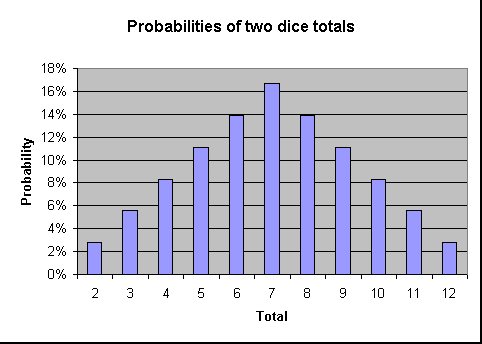
Here is one that uses Probability with math as a percent. In Craps we say that a two can happen once in 36 times on average. That is 1/36, or .0278, or 2.78%.

Posted by: Guest on August 16, 2012, 7:37 pm

Probabilities can be shown as a fraction, decimal, or percentage

Dice Pyramid[/tds]
[/tds]
[/tds]
[/tds]

[/tds]

[/tds]

[/tds]

[/tds]

[/tds]

6:1[/tds]

[/tds]

[/tds]

[/tds]

[/tds]

[/tds]

[/tds]
[/tds]

[/tds]

[/tds]

[/tds]

[/tds]

5:1[/tds]

5:2[/tds]

6:2[/tds]

[/tds]

[/tds]

[/tds]

[/tds]

[/tds]
[/tds]

[/tds]

[/tds]

[/tds]

4:1[/tds]

4:2[/tds]

4:3[/tds]

5:3[/tds]

6:3[/tds]

[/tds]

[/tds]

[/tds]

[/tds]
[/tds]

[/tds]

[/tds]

3:1[/tds]

3:2[/tds]

3:3[/tds]

3:4[/tds]

4:4[/tds]

5:4[/tds]

6:4[/tds]

[/tds]

[/tds]

[/tds]
[/tds]

[/tds]

2:1[/tds]

2:2[/tds]

2:3[/tds]

2:4[/tds]

2:5[/tds]

3:5[/tds]

4:5[/tds]

5:5[/tds]

6:5[/tds]

[/tds]

[/tds]
[/tds]

1:1[/tds]

1:2[/tds]

1:3[/tds]

1:4[/tds]

1:5[/tds]

1:6[/tds]

2:6[/tds]

3:6[/tds]

4:6[/tds]

5:6[/tds]

6:6[/tds]

[/tds]
[/tds]
[/tds]

2[/tds]

3[/tds]

4[/tds]

5[/tds]

6[/tds]

7[/tds]

8[/tds]

9[/tds]

10[/tds]

11[/tds]

12[/tds]

[/tds]
[/tds]
Random[/tds]

[/tds]

[/tables] [clear][/clear]

Posted by: Finisher on August 17, 2012, 3:15 am

Cll I LIKE LOOKING AT YOUR CHARTS . Looking at the math is not the same. Keep the charts coming.
I was hoping that more would respond to this post .
I also love your pics too.
Good Rolling. πŸ˜€

Posted by: Finisher on January 21, 2013, 6:17 am

Pat
Dice Probability
Number[/tds]

Number of Ways to make[/tds]

Probability as a Fraction[/tds]

Probability as a Decimal[/tds]

Probability as a Percent[/tds]
2[/tds]

1[/tds]

1/36[/tds]

.02778[/tds]

2.78%[/tds]
3[/tds]

2[/tds]

2/36[/tds]

.05556[/tds]

5.56%[/tds]
4[/tds]

3[/tds]

3/36[/tds]

.08333[/tds]

8.33%[/tds]
5[/tds]

4[/tds]

4/36[/tds]

.1111[/tds]

11.11%[/tds]
6[/tds]

5[/tds]

5/36[/tds]

.1389[/tds]

13.89%[/tds]
7[/tds]

6[/tds]

6/36[/tds]

.1667[/tds]

16.67%[/tds]
8[/tds]

5[/tds]

5/36[/tds]

.1389[/tds]

13.89%[/tds]
9[/tds]

4[/tds]

4/36[/tds]

.1111[/tds]

11.11%[/tds]
10[/tds]

3[/tds]

3/36[/tds]

.08333[/tds]

8.33%[/tds]
11[/tds]

2[/tds]

2/36[/tds]

.05556[/tds]

5.56%[/tds]
12[/tds]

1[/tds]

1/36[/tds]

.02778[/tds]

2.78%[/tds]
TOTAL[/tds]

36[/tds]

36/36[/tds]

1.0[/tds]

100%[/tds]